


The Ghost Story at the Heart of Christmas


In 1848, Charles Dickens sat down to write a Christmas story. He called it "The Haunted Man" and it featured a chemist tormented by a phantom that was his own double. It was, by any measure, a ghost story and it was also, unambiguously, a Christmas story. To Dickens and his Victorian readers, there was nothing contradictory about that at all.
Christmas and ghost stories feel like odd bedfellows now, one associated with warmth and generosity, the other with darkness and dread. But for much of the nineteenth century they were natural companions, and it was Dickens more than anyone who made them so.
The tradition has older roots than Dickens, of course. The long dark nights of midwinter have always invited stories of the uncanny. In an age before electric light, when the darkness was genuinely dark and the cold genuinely cold, gathering around a fire to frighten each other made a peculiar kind of sense. A theme just as familiar to Shakespeare when, in The Winter's Tale, a character calls for a sad tale to be told, "for winter," he says, "a sad tale's best for winter. I have one of sprites and goblins."
But it was the Victorians who turned it into something close to a national institution, and Dickens who led the charge. He edited literary magazines that published ghost stories throughout December, writing several of his own, and understood instinctively that the season of goodwill and the season of the uncanny were not opposites but complements. Both ask us to look beyond the everyday and remind us that the world contains more than we can see.
A Christmas Carol is itself, at its heart, a ghost story. It's easy to forget this when the ending is so joyful, the redemption so complete, that the supernatural machinery that drives it can feel incidental. But Scrooge is visited by four spirits, and all four are explicitly ghostly. The first, Jacob Marley, is as terrifying a figure as anything in the Victorian canon.
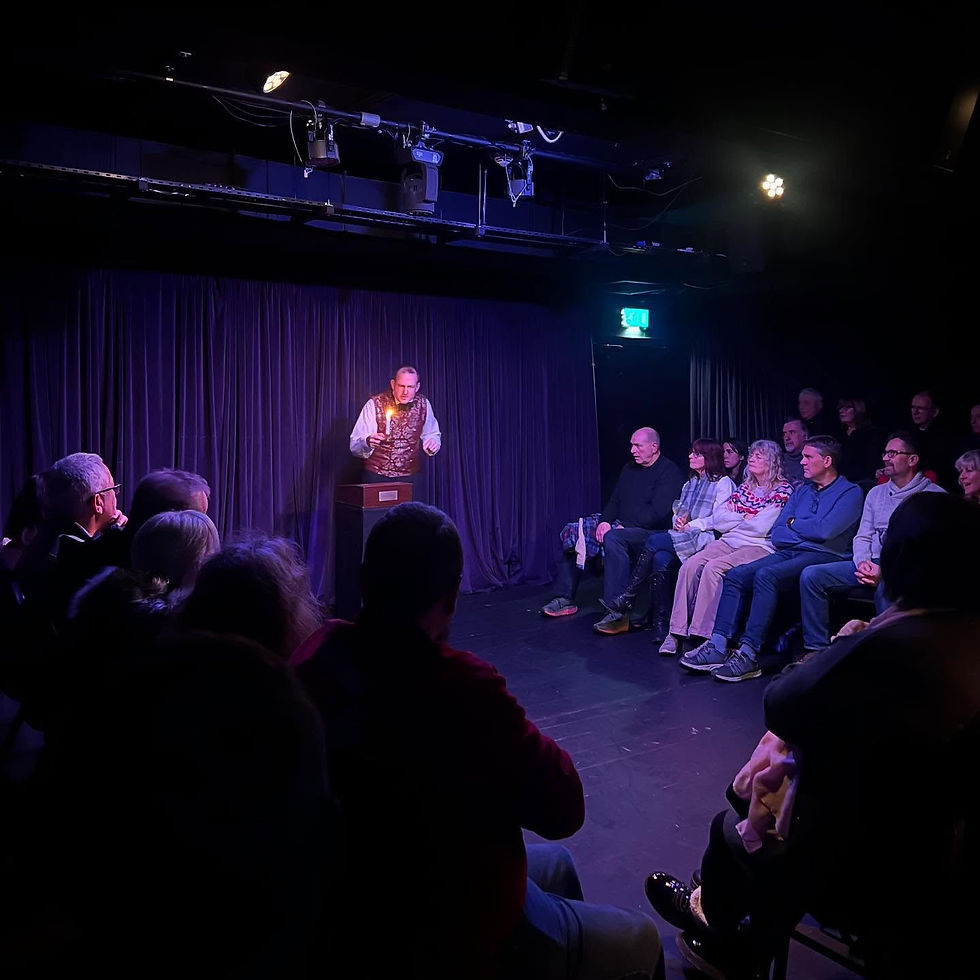
In my own performance, the show is deliberately minimal. However, the arrival of Marley is preceded by the high tinkling of bells, the service bells of Scrooge's house ringing out in unison echoing themes of the spiritualists of his time, followed by the slow dragging of chains. By that point in the show the audience has had nothing of the kind, and the effect is considerable. I can feel the room shift. People hold their breath. And then he arrives.
The Ghost of Christmas Yet to Come shifts the tone in an altogether different way. He follows immediately on the heels of the Ghost of Christmas Present, whose disappearance is sudden, and his arrival brings with it a marked tonal change. Where the earlier spirits were voluble, almost jovial in some cases, this one is silent. Scrooge becomes visibly anxious and the audience feels it. It's the moment in the show where the ghost story asserts itself most completely, and where Scrooge's redemption becomes not just desirable but urgent.
The tradition didn't die with the Victorians. The BBC has kept it alive for decades with its multitude of ghost story adaptations broadcast on Christmas Eve, those quiet, creeping stories of academics encountering things they cannot explain in churches and archives and lonely country houses. There is something about that format, the short story, the single sitting, the unresolved dread, that suits the season perfectly. It asks you to sit still and pay attention in the dark, which is not such a bad thing to do in December.
So if you find yourself drawn to something a little less glittery this Christmas, you are in good company. Dickens would understand completely.


Comments