


Why I Never Change a Word


There is a word in A Christmas Carol that nobody uses any more. Scrooge, waking on Christmas morning in a state of giddy redemption, calls out to a boy in the street and sends him to buy the prize turkey. The boy, understandably suspicious of this sudden transformation in a man famous for his meanness, responds with a single word. Walk-ER!
It means, roughly, "I don’t believe you for a moment." The Victorian equivalent of "pull the other one." Nobody says it any more ,but I never change it and the audience, without exception, understands exactly what the boy means, partly from context, partly from the delivery, and partly because human scepticism has not changed very much in 180 years.
That’s the thing about language. Given the right context, the right delivery and a performer who understands precisely what the author intended, words find their way across two centuries without needing a translator.
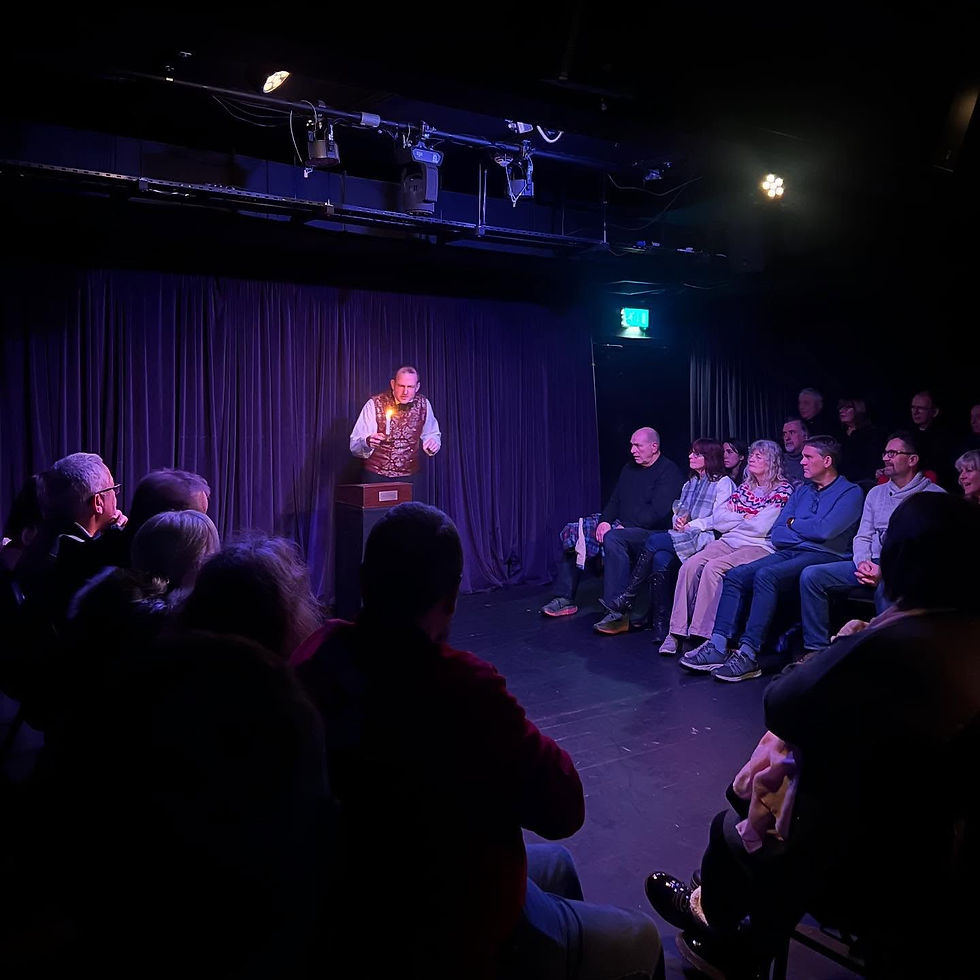
When I first performed A Christmas Carol, the rule I set myself was absolute. Not a single word would be changed. No updating for a contemporary audience, no smoothing of unfamiliar phrases, no substituting a simpler word for one we no longer use. What I wanted to create was an experience that a Victorian listener would have recognised. The sense that the author himself was in the room, speaking directly to the audience, and that I was simply the means by which his words arrived.
Dickens understood this better than anyone. He didn’t just write A Christmas Carol. He performed it repeatedly to packed houses across Britain and America, reading from his own abridged version of the text. It is that version, roughly one third of the original novella, that I perform today. What remains is what Dickens himself chose to keep and what is missing is what he decided, for the purposes of a live performance, was not essential. I did not have to guess at his intentions because he left them on the page.
I wasn’t so fortunate with The Wind in the Willows. Kenneth Grahame never created a performance version of his own book, so the abridgement for that show is mine, made over three painstaking months with the same rule firmly in place. Every word that remains is Grahame's, in Grahame's order. I’ve only ever added some punctuation to help it flow out loud. Whether I kept all the right bits is a matter of opinion, though I comfort myself that nobody has yet told me their favourite part is missing. Fortunately, with A Christmas Carol, I can simply defer to the author.
Performing original texts without adaptation is not always the easier path. There are passages where honouring the original words can make the meaning less immediately clear to modern ears than a slight rephrasing might. This means that for every line I perform, I need to understand not just what it says but what it means, what it meant to a contemporary reader, and how to make that meaning land without changing a syllable.
There is a moment after Tiny Tim's death where we see his mother doing needlework by candlelight. She complains that the colour hurts her eyes. The narrator observes, quietly, "the colour. Ah, poor Tiny Tim." A Victorian audience would have understood immediately that she is sewing black mourning clothes in poor light, which is difficult on the eyes, and this detail confirms without stating it that Tiny Tim is gone. A modern audience does not necessarily carry that knowledge, so the passage requires something more from me, a weight in the delivery, a pause, a clarity of expression that makes the meaning arrive even if the cultural reference does not.
There is a version of both shows I could perform that would be easier in places, smoother, more immediately accessible. But it would not be Dickens. It would not be Grahame. It would be me, wearing their clothes, and that is not what either of them deserves.
I sometimes think about one of the greats from much earlier in the literary tradition. Much of Shakespeare does not make obvious sense to a modern audience either, and yet we do not always rewrite him, we learn to meet him where he is. Dickens is barely 180 years old. The least I can do is the same.


Comments